

NASHVILLE, Tenn. — The Metro Nashville Public School (MNPS) Board has taken a significant step towards enhancing school safety by approving a $1 million-plus contract to implement gun detection software across the district. The decision, made on Tuesday, marks a major investment in security technology designed to detect firearms and potentially prevent dangerous situations.
The contract, awarded to Omnilert, is set to begin on March 23 and will remain in effect through November 30, 2025. With a budget capped at $1,050,487.80, the agreement will be split across two years. Omnilert’s CEO, Dave Fraser, emphasized the growing demand for solutions addressing active shooter threats. “Over the last few years, the number one issue among our customers has been the threat of active shooters,” Fraser stated.


Omnilert’s innovative system leverages artificial intelligence to identify firearms in real-time. According to Fraser, the technology works by recognizing when someone is holding a gun, whether it’s a handgun or a rifle. “When there is a video image with a gun, as long as a human being can see it, the system picks it up in a fraction of a second,” Fraser explained. A demonstration video provided by the company illustrated how the system immediately detects a firearm as soon as a person enters the camera’s view holding one.
Unlike traditional security measures such as metal detectors, this system offers extensive coverage, capable of monitoring larger areas like parking lots and cafeterias. This flexibility is seen as a crucial advantage in enhancing school safety.
The move to adopt this advanced technology follows heightened concerns about school safety, particularly after the tragic Uvalde elementary school shooting. In response to the incident, MNPS leaders, including Director of Schools Dr. Adriene Battle and Metro Nashville Police Chief John Drake, held a joint press conference to discuss new safety protocols. Topics included increasing the presence of School Resource Officers and exploring the potential use of metal detectors. Board member Rachael Anne Elrod also raised questions about measures such as requiring clear backpacks and ongoing discussions around metal detectors during a June 2022 meeting.
While the gun detection system represents a proactive approach to safety, it’s not without limitations. Fraser acknowledged that the technology is not foolproof and may occasionally produce false positives. Despite this, he stressed that the system empowers schools by providing instant alerts. “The detection takes a fraction of a second, but immediately after that, the information is sent to responders,” Fraser explained. “Whether they want to issue a lockdown, set off alarms, or take other actions, it’s all streamlined into a single click.”
The contract encompasses various components, including annual camera and hardware subscriptions, initial setup, and ongoing monitoring services. These elements aim to integrate the system seamlessly into MNPS’s existing security infrastructure, which includes over 1,300 cameras.
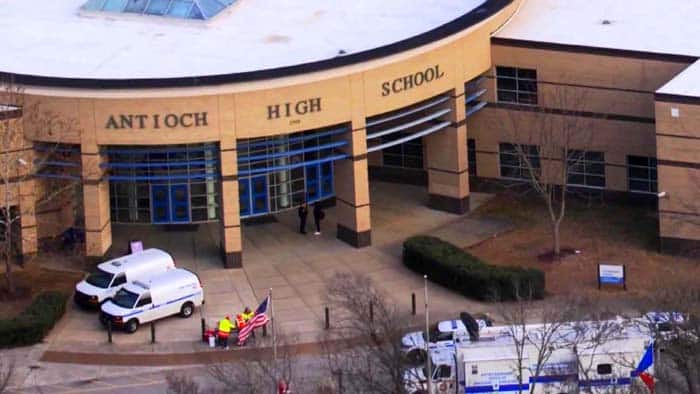
Despite the promising capabilities of the Omnilert system, the decision to allocate over $1 million to this technology has sparked debate. Representatives from the Metropolitan Nashville Education Association (MNEA) voiced concerns during Tuesday’s board meeting. Hallie Trauger, an MNEA member and teacher at Antioch High School, argued that the district’s limited staffing poses a greater safety risk than the lack of advanced technology. “In practice, given the limitations of the software, the chance that it would detect a weapon in a place where no one else could see it seems unlikely,” Trauger said. “If such a scenario occurs, it’s more a reflection of our schools being understaffed.”
Trauger emphasized the importance of investing in personnel to monitor hallways, secure entrances, and engage with students and visitors. “Ensuring that we are fully staffed allows us to respond and intervene appropriately when necessary,” she added.
Other MNEA members echoed this sentiment, holding signs that read “Understaffing is a safety issue” during the meeting. Nancy Holland, a former MNPS teacher who now works as a substitute, expressed frustration over the allocation of funds. “None of this money is going toward significant safety issues,” she said, highlighting the need for better pay and support for existing staff despite last year’s pay increase.
An MNPS spokesperson explained that the contract has been under consideration for months. “The district has been working with our security camera provider, System Integrations, Inc., to identify products that enable a weapon detection feature for the 1,300+ security cameras installed throughout the district,” the spokesperson stated. The Omnilert system will serve as an add-on feature, providing AI-based detection, hardware for servers, and human-reviewed monitoring of alerts flagged by the software.
As MNPS prepares to implement this technology, the district faces the challenge of balancing technological advancements with the need for human resources. While the gun detection system offers a cutting-edge solution to enhance safety, many educators believe that investing in staff remains the most effective way to protect students and create a secure learning environment.
This pivotal decision underscores MNPS’s commitment to addressing safety concerns while navigating the complexities of resource allocation. As the Omnilert system becomes operational, the district and its stakeholders will closely monitor its effectiveness in preventing potential threats and ensuring the safety of students and staff alike.


